Sunday, June 7th 2026 Reporter: Dessy Suciati Translator: Nugroho Adibrata 68
(Foto: Nugroho Sejati)
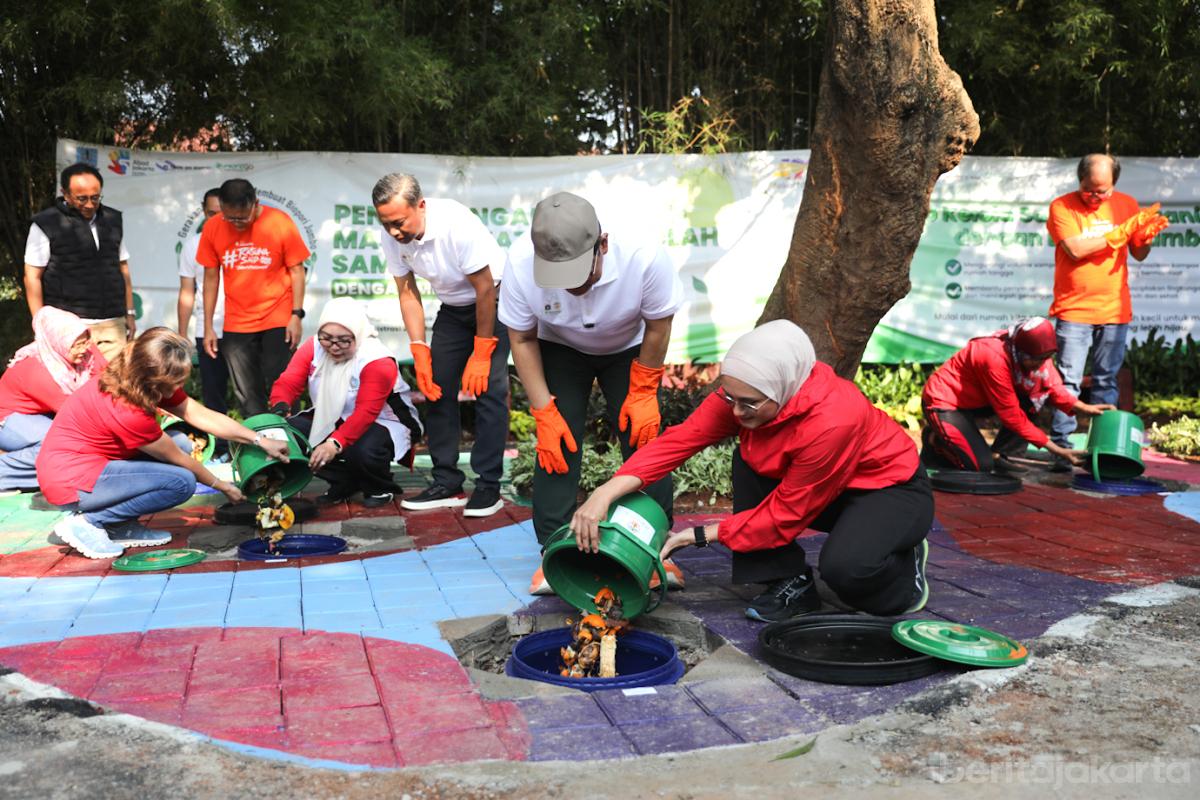
Jakarta Governor Pramono Anung officiated an organic waste processing program using jumbo biopores in Pondok Kelapa, East Jakarta, Sunday (6/7).
Appreciating the community-led effort, Pramono highlighted its effectiveness in tackling waste problems upstream.
We commend RW 14 and its six RTs for initiating this jumbo biopore method
"We commend RW 14 and its six RTs for initiating this jumbo biopore method to manage their local waste," he expressed.
The community had already made this organic waste processing movement prior to the enactment of Gubernatorial Instruction No. 5/2026. He suggested that such self-sufficient waste management efforts should become a blueprint for other Jakarta areas.
"Should this prove successful, it will become a role model for tackling waste issues throughout Jakarta," he explained.
He underscored the Jakarta administration's commitment to tackling the capital's waste problems, noting that waste management—driven by waste-sorting movements—is being rigorously implemented.
"We are pursuing this with total seriousness as we are committed to fully executing the Central Government’s mandates for Jakarta. This encompasses the handling of Bantar Gebang, Rorotan, and overall field operations," he explained.
Jakarta government has prepared several waste management strategies, such as operating the Rorotan RDF Plant, constructing Waste-to-Energy facilities, and handling waste at the Bantar Gebang Landfill.
"Further, I have given the green light in principle for the Ciangir area in Banten to store our compost," Pramono continued
Pramono believes that a holistic execution of these strategies will successfully address the roughly 9,000 tons of waste produced by Jakarta every day.
On the same occasion, RW 14 Chair in Pondok Kelapa, Tengku Husaini, noted that his community had initiated organic waste processing three years before Gubernatorial Instruction No. 5/2026 was enacted.
"We had already started, but this Instruction has pushed us to be even more serious, leading us to create jumbo biopores. Our aim is for all organic, kitchen, and household waste to go into these biopores so we can reach a zero-waste target," he explained.
As for inorganic waste with resale value—such as plastic bottles and cardboard—management is handled via Waste Banks, ensuring that only residual waste is sent to the Bantar Gebang Landfill.
Thus far, RW 14 has installed 130 biopores and aims to add another 200 sites to manage the community's organic waste.
![<?//= $potret[0]->photo_filename ?>](https://multimedia.beritajakarta.id/photo/potret-jakarta/2026/06/xSv2WJ5WcNxVZ2CSm2Wi9zKXOhN0qO6A.jpg)