Tuesday, November 25th 2025 Reporter: Nurito Translator: Rizky Mawardi 243
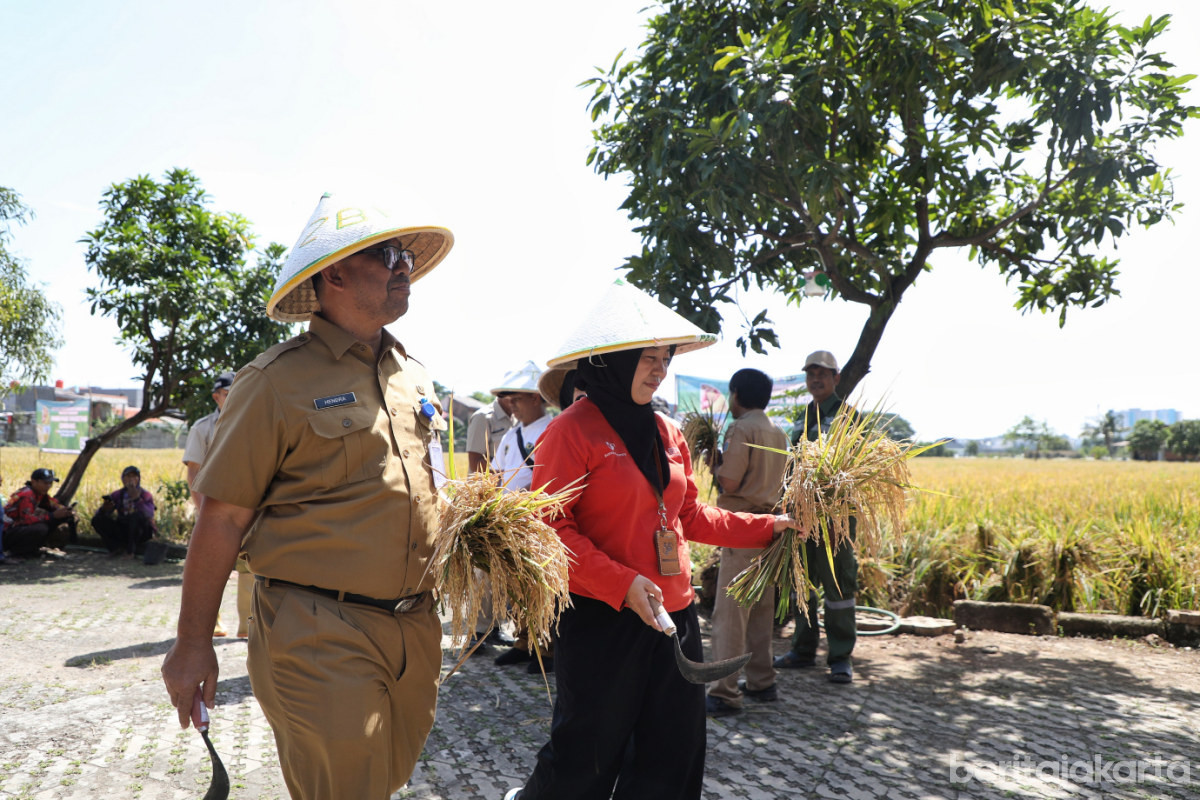
(Foto: Andri Widiyanto)
As many as 9.2 tons of paddy were harvested at Seedling Garden on Jalan Tambun Rengas, RT 01/08, Ujung Menteng Urban Village, Cakung District, East Jakarta. The harvesting process on the land measuring approximately 1.9 hectares was led by the Head of the UPT Center for Seed Development and Plant Protection of the Jakarta Food Security, Maritime and Agriculture Agency, Hendra Junianto.
maintaining food security
Harvesting was run using a unit of automatic heavy equipment, a combine harvester or rice harvesting machine, so the process is faster than the manual method.
Hendra said this harvest produced superior-quality grain. The increased yield was driven in part by the application of Plant Growth Promoting Rhizobacteria (PGPR) to the rice seeds before the nursery stage.
According to him, PGPR is a group of beneficial bacteria that are able to colonize the rhizosphere or a thin layer of soil around the roots, thus having a positive impact on plant growth.
"As a form of commitment to maintaining food security and preserving agricultural land," he said, Tuesday (11/25).
Hendra explained that the harvested rice was the Ciherang variety, a superior variety favored by farmers due to its high yield potential, easy maintenance, and suitability for planting in irrigated areas during both the rainy and dry seasons. Furthermore, this variety can grow in lowlands up to 500 meters above sea level.
"The rice harvest at this location is a routine activity every four months. The harvested rice is not milled into rice, but rather used as seeds. These superior seeds are expected to meet the needs of farmer groups and will be distributed to farmers in Jakarta," he explained.
Meanwhile, Head of East Jakarta BPS, Septiana Tri Setiowati stated her side task is to assess and photograph agricultural conditions in Jakarta. Currently, there are three rice farming locations in East Jakarta namely the Ujung Menteng Seed Garden, the Ujung Menteng Eternal Rice Fields, and the Halim Perdanakusuma agricultural area.
"According to our records, in 2024, with a harvest area of 28 hectares and two harvests a year, East Jakarta's special rice production reached 172 tons," she stated.
She explained that the harvest calculation process is run using the Area Sample Framework (ASF) method, which is an objective method that integrates spatial data from satellite imagery and land maps with field data to determine the harvest area.
Once the harvested area is obtained, this figure is multiplied by the productivity from the tile survey to calculate total production. This method has been used for decades.
"I hope that even though the rice harvest cannot yet meet all food needs, the existence of this agricultural land will still be a form of support for food security in Jakarta," she admitted.