Wednesday, November 19th 2025 Reporter: Budhi Firmansyah Surapati Translator: Nugroho Adibrata 283
(Foto: Nugroho Sejati)
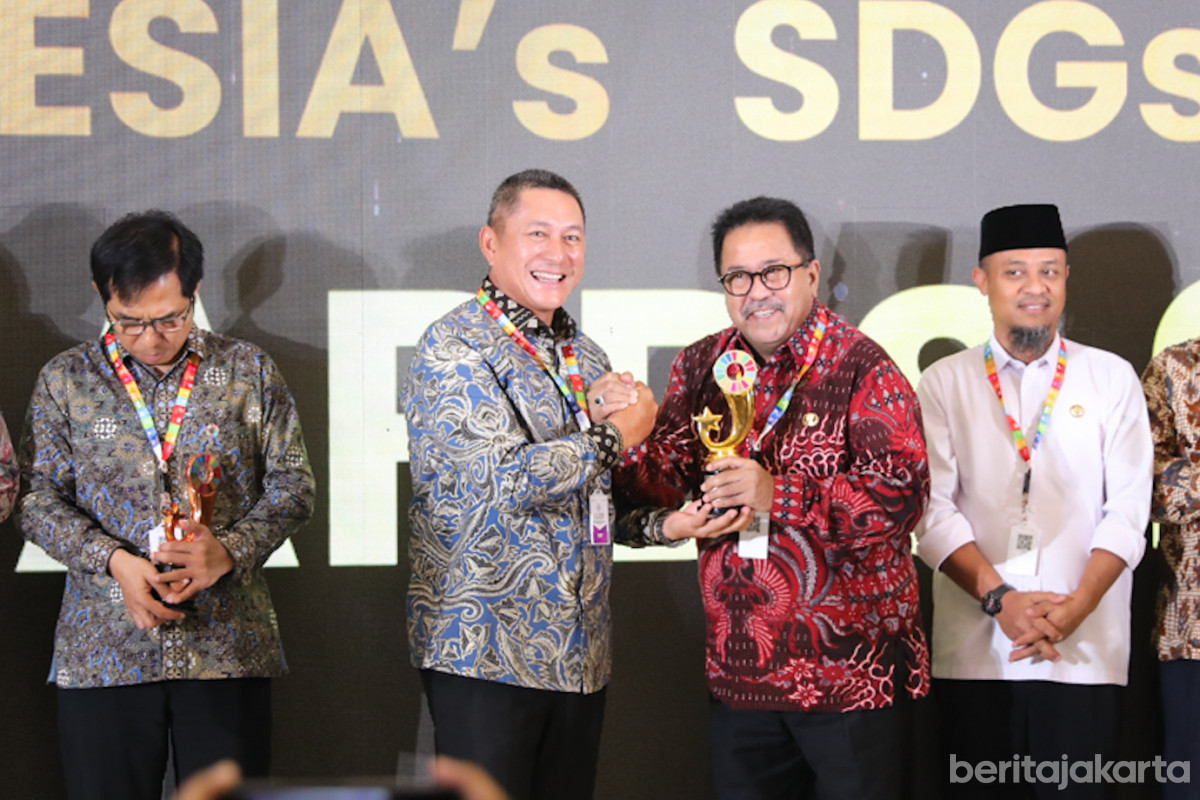
The Jakarta government won first place in the provincial category at the Sustainable Development Annual Conference (SAC) 2025 organized by the Ministry of National Development Planning (PPN)/National Development Planning Agency (Bappenas). The second place was awarded to South Sulawesi Province, and the Special Region of Yogyakarta (DIY) took third place.
Jakarta's vision as a progressive, just, and sustainable global city
The award was received directly by the Deputy Governor of Jakarta, Rano Karno, at the Bappenas Office, Jalan Taman Suropati, Menteng, Central Jakarta, Wednesday (11/19).
This award was received by Jakarta for being consistently committed to accelerating the achievement of sustainable development goals (SDGs) through various innovative policies and programs that have a direct impact on the community.
"We express our gratitude to all ranks, partners, and the Jakarta community who continue to support the collaborative efforts to build a more advanced and competitive Jakarta," he explained.
Thus far, the Jakarta government has implemented various flagship programs in line with the central government policies, particularly the priorities of the 2025–2029 National Medium-Term Development Plan (RPJMN), with an emphasis on improving the quality of human resources.
One of the strategic programs implemented is Free Nutritious Food (MBG), an integrated effort to ensure that school children, toddlers, students, as well as pregnant and breastfeeding women, have access to adequate and sustainable nutrition.
"Jakarta's vision as a progressive, just, and sustainable global city in line with the principles of the SDGs," he explained.
To strengthen its implementation, Rano explained, the Jakarta government formed the SDGs Coordination Team led by Governor Pramono Anung and coordinated by the Head of Bappeda, involving regional agencies, academics, the business sector, media, community organizations, and philanthropy.
As of 2024, Jakarta has met 77 out of 118 SDG indicators. One of the programs that contributes significantly is the policy to strengthen food security through subsidized food.
This policy targets vulnerable groups who, according to BPS Susenas 2024 data, still allocate 30-45 percent of their income for food needs.
As the implementation foundation, the Jakarta government issued Governor Regulation Number 28/2022 on Subsidized Affordable Food.
As a result, from 2017 to 2025, the price of essential food packages can be maintained around Rp 126,000, or about 40–50 percent cheaper than market prices.
"This program is also part of the Jakarta government's strategy to reduce stunting and malnutrition," he explained.
He added that in 2025, the number of beneficiaries of subsidized food reaches 992,497 people. The largest group is KJP Plus recipients, totaling 671,573 people, followed by the elderly with 154,175 people.
Besides students with limited financial means receiving the KJP and the elderly, other beneficiaries of subsidized food programs include the disabled, low-income workers, residents of flats, non-PNS teachers, and PKK cadres. The recipient data is managed jointly by DKPKP and Bank Jakarta.
The subsidized food program is also integrated with MBG, creating a comprehensive nutritional protection ecosystem, from schools to families.
Rano emphasized the Jakarta government's commitment to continue pursuing the SDGs targets, especially poverty alleviation, hunger eradication, economic improvement, and reducing inequality.
"This award is not the end but rather an encouragement for us to continue strengthening collaboration and making the SDGs a roadmap for Jakarta's development," he asserted.
Jakarta Bappeda Head, Atika Nur Rahmania, expressed gratitude for the guidance of the governor and deputy governor, who motivated the entire team to achieve the first-place award in SDGS action.
"Besides focusing on several SDGs goals, the ability to manage food becomes Jakarta's strength," she expressed.
He added, in managing food security, Jakarta has many programs that are consistently conducted continuously. These include urban farming, greening, a well-controlled food distribution team, and food subsidies.
According to him, the achievement of the SDGs demonstrates that the Jakarta government's consistent efforts over the past few years have yielded very good results and have surpassed some other regions.
Besides various programs, one of the keys to Jakarta's victory is also because it has established and pioneered the formation of Voluntarily Local Reviews.
"Of course, we can continue to consistently maintain this achievement in the future," he stated.