Friday, October 2nd 2026 Reporter: Aldi Geri Lumban Tobing Translator: 55 107
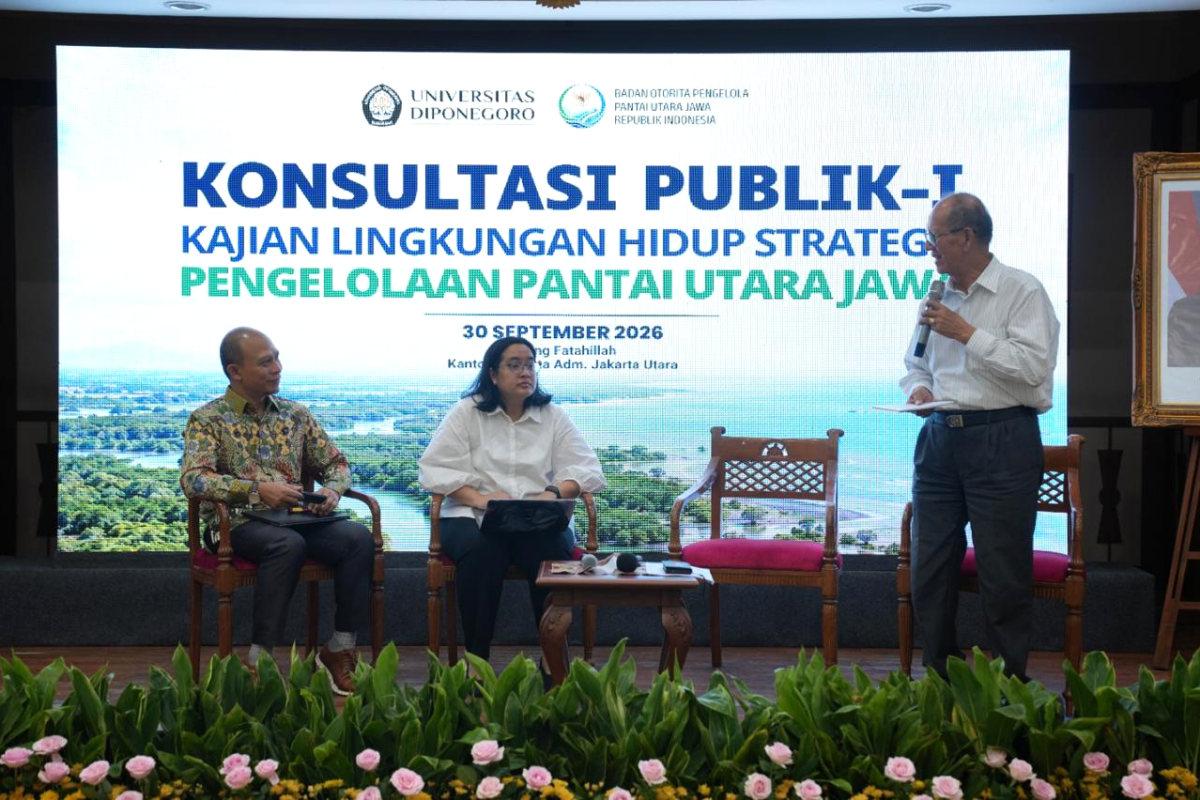
(Foto: Istimewa)
The Jakarta government is advancing the protection plan for the North Coast of Java—including the construction of a Giant Sea Wall (GSW)—as part of an integrated coastal defense system.
Beyond addressing the threats of tidal flooding and shifting coastal dynamics, the planning must also safeguard the environment, human habitats, and the livelihoods of communities that have long depended on the coastal region. This principle constitutes a core consideration in formulating the Strategic
Jakarta’s coast is a unified system
Environmental Assessment (SEA), which is carried out through a public consultation process involving the government, academics, coastal residents, and diverse stakeholders.
Jakarta Environmental Agency Head Dudi Gardesi, stated that Jakarta’s northern coast is a region of immense strategic importance as well as complexity.
He stated that the area encompasses residential settlements, fishing activities, ports, industries, commerce, transportation, and various critical infrastructure vital to the city.
"Hence, when we discuss the northern coast and the Giant Sea Wall, we can't view it merely as the construction of a seawall. Jakarta’s coast is a unified system, extending from the mainland, rivers, and estuaries to the coastline and the sea. Everything is interconnected and must be viewed holistically," he expressed, Friday (10/2).
He noted that the development of coastal protection infrastructure is indeed essential to address the various risks confronting Jakarta. However, any proposed solutions must also account for the environmental carrying capacity and the well-being of communities living and earning their livelihoods in the coastal zone.
"This is why the SEA is crucial. We want the development to provide protection for Jakarta, while at the same time ensuring that environmental concerns and community needs are factored in right from the planning stage," he added.
Dudi explained that community engagement is a vital component, as coastal residents possess firsthand knowledge of their region's conditions. Insights regarding fishermen's access, sedimentation, environmental quality, and local economic activities serve to complement the technical studies conducted by the government and experts.
He noted that managing the northern coast cannot be undertaken by a single institution alone, given that the region forms a contiguous landscape spanning across administrative boundaries, sectors, and jurisdictions.
"Thereby, the Jakarta government is fostering robust collaboration among the central government, regional authorities, local communities, academics, the business sector, and all stakeholders. The objective is singular: to secure enhanced coastal protection for Jakarta while ensuring that such development remains sustainable," he explained.
Meanwhile, Benni Aguscandra, Deputy 1 for Regional Management of Banten, Jakarta, and West Java at the North Coast of Java Management Authority Body (BOPPJ), stated that the northern coast protection plan constitutes an integral part of national policy, as mandated by Presidential Regulation Number 12/2025 on the 2025–2029 National Medium-Term Development Plan (RPJMN) and Presidential Regulation Number 77/2025 on the North Coast of Java Management Authority Body.
He noted that the threats of sea-level rise and land subsidence represent critical challenges that require proactive anticipation across the northern coast.
"At the same time, the region also serves as a vital hub for human settlements, infrastructure, and economic activities, thereby demanding a comprehensively planned protection system," he explained.
He stated that the protection approach for the northern coast does not rely solely on offshore sea dikes. In several areas, coastal dikes are also being considered alongside nature-based solutions—such as a combination of mangroves and breakwaters—tailored to the specific conditions of each region.
He explained that for the Jakarta Bay area, one of the planned protection segments spans from the Ciliwung River to the Cikarang Bekasi Laut (CBL) River in Bekasi.
Benni emphasized that coastal protection must not stop at physical development alone. The social and economic dimensions of communities who have long lived and worked in the coastal area must also be factored into the planning.
"The President's mandate is clear: coastal communities represent a primary focus. Hence, what is being developed is not just the infrastructure, but also ensuring that the community's social, economic, and livelihood aspects remain fully integrated into the planning," he elaborated.
In line with this, Denny Nugroho Sugianto, a member of SEA Expert Team from Diponegoro University, explained the SEA is necessary to ensure that every coastal protection intervention option accounts for existing environmental conditions and does not impose new pressures on the ecosystem.
He noted that the assessment must begin with existing baseline conditions, including the Environmental Carrying and Assimilative Capacity (D3TLH).
"Coastal issues must also be viewed from upstream to downstream, ranging from land subsidence, sedimentation, and waste to potential pollution carried through river basins into Jakarta Bay," he added.
Aside from environmental considerations, the needs of coastal communities represent an inseparable element. Fishermen's access to the sea, fuel availability, sedimentation, vessel access, and the sustainability of residents' livelihoods must all be factored into policy formulation.
"The objective is to ensure that coastal protection is not only robust in terms of infrastructure, but also capable of harmonizing with the environment and the community life that has long established itself in the region," he concluded.
![<?//= $potret[0]->photo_filename ?>](https://multimedia.beritajakarta.id/photo/potret-jakarta/2026/10/5MAkBWaaeAmYRx5P3H35gki0ijp5y6Ol.jpg)