Monday, September 28th 2026 Reporter: Tiyo Surya Sakti Translator: 138 153
(Foto: Tiyo Surya Sakti)
The Jakarta Provincial Government is stepping up source-based waste management by developing a system that ensures waste is sorted at home before being collected, transported, and processed separately according to type.
We need to strengthen waste management at the source
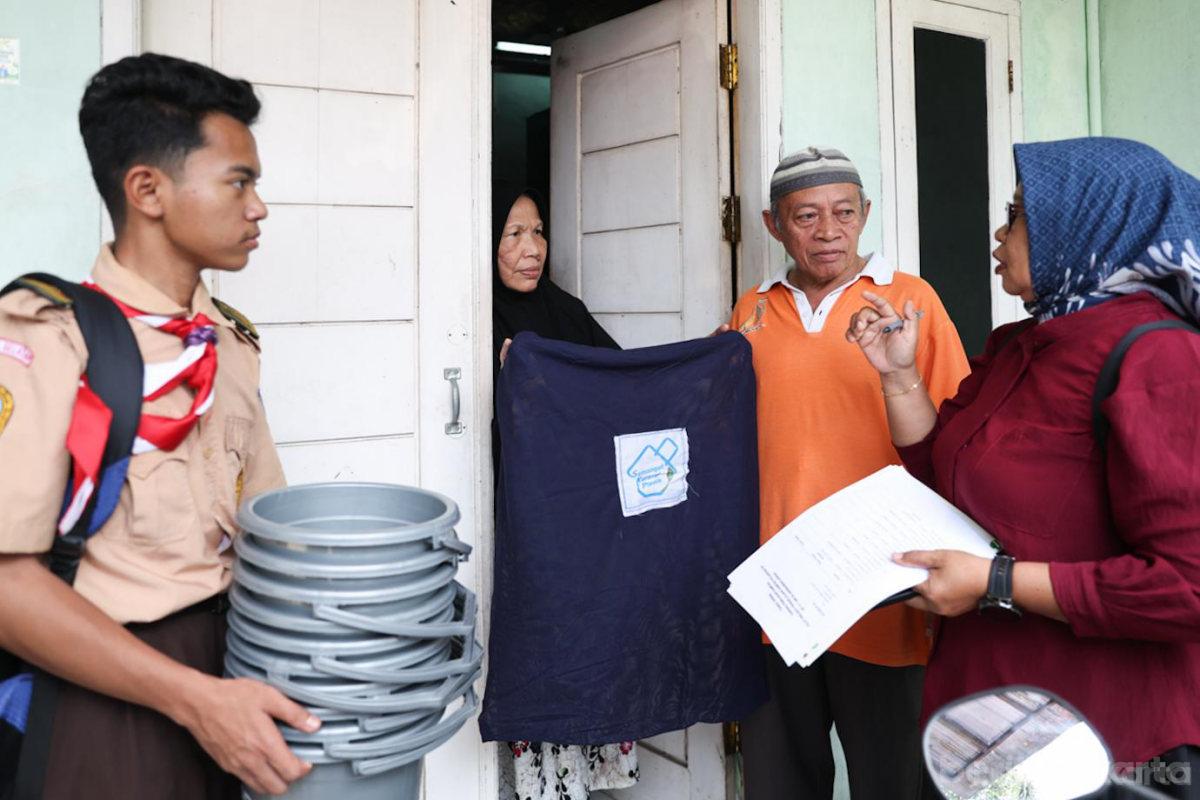
The effort is being implemented through a Collaborative Waste Management Pilot Project in RW 06, Srengseng Sawah Urban Village, Jagakarsa Sub-district, South Jakarta. Under the program, more than 400 households receive door-to-door education and assistance, along with waste-sorting facilities.
Jakarta Environment Agency Head Dudi Gardesi emphasized that Jakarta is shifting its waste management approach from collect-transport-dispose to managing waste from the source.
"The waste problem cannot be solved only at the downstream end. We need to strengthen waste management at the source so that as much waste as possible can be sorted and processed before reaching final processing facilities. That's why we are promoting not just a waste-sorting movement, but a complete system for sorting, collecting, transporting, and processing waste," he said on Monday (9/28).
Dudi explained that the program is part of the Waste Management Cluster under the Large-Scale Social Collaboration (KSBB) Environmental Affairs Program and supports the implementation of Gubernatorial Instruction (Ingub) No. 5/2026 on the Waste Sorting and Processing Movement at the Source.
He said community participation must be supported by a consistent system. Waste that has been sorted at home must not be mixed again during collection or transportation.
"The government must ensure continuity from the household level through collection, transportation, and processing. We hope this pilot project can serve as a model that can be evaluated, improved, and gradually developed in other areas," he noted.
Jakarta Environment Agency Deputy Head Purwanti Suryandari added that the program in RW 06, Srengseng Sawah Urban Village, was designed to ensure that waste sorting goes beyond education and is followed by separate collection, transportation, and processing.
"What we want to establish on the ground is a clear waste management chain, from sorting at home to separate collection, transportation, and processing. Residents sort their waste at home, after which it is collected and transported separately and sent to processing facilities according to type," she said.
Purwanti explained that, as part of efforts to support lower- and middle-income households, the agency provides a special bucket in each home for separating organic waste. The organic waste is then collected according to a regular schedule.
The Jakarta Provincial Government has also provided several drop-off points around the neighborhood. Waste deposited at these points is collected directly by waste collection personnel or cart operators.
"Jagakarsa was selected as the pilot project site because its waste-sorting rate is still relatively low, even though residents and local RT/RW administrators are considered to have relatively high awareness," she pointed out.
Purwanti said the system in RW 06, Srengseng Sawah Urban Village, was also developed through a co-design approach involving residents, the government, communities, businesses, and universities.
The approach was adopted to ensure that the waste management model is suited to the characteristics and needs of the local area and can operate sustainably.
"This pilot project is a learning process for developing a consistent system from the upstream stage through processing," she stressed.
Meanwhile, South Jakarta Assistant for Economic and Development Affairs Iwan Santoso said source-based waste sorting continues to be expanded.
"Currently, around 21,000 households in South Jakarta have implemented waste sorting at the source, supported by various organic waste processing facilities such as jumbo biopores and modern teba systems," he noted.
Iwan added that through door-to-door assistance, residents can see and practice how waste sorting is carried out.
"Organic waste that was previously thrown away can also be processed into compost or planting media that benefits the environment," he said.
![<?//= $potret[0]->photo_filename ?>](https://multimedia.beritajakarta.id/photo/potret-jakarta/2026/09/3hU7h8rbwFABExLo6dj12217rNYzhI3b.jpg)