Thursday, July 23rd 2026 Reporter: Nurito Translator: Maria Inggita 542
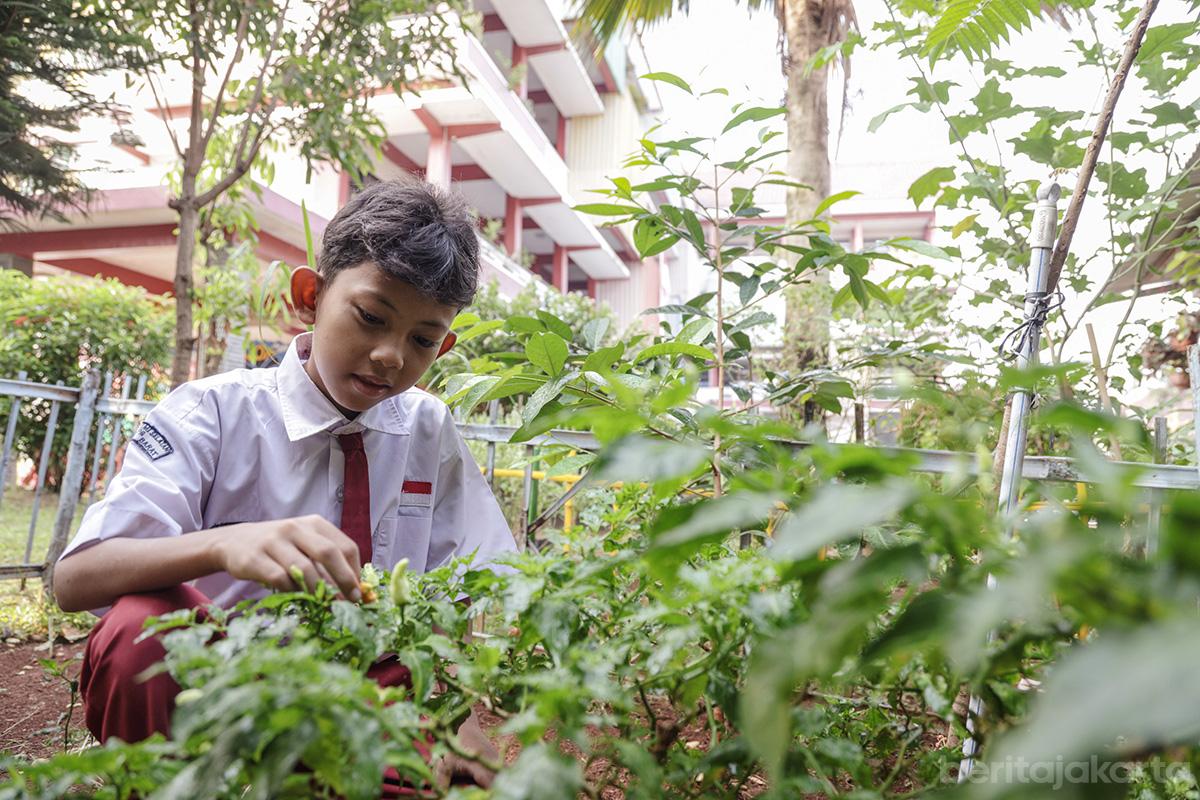
(Foto: Bilal Nugraha Ginanjar)
The East Jakarta Food Security, Marine and Agriculture (KPKP) Sub-agency is encouraging schools to become greener and more productive by making use of school grounds for urban farming.
Not only growing plants but also cultivating knowledge, environmental awareness, and habits that support food security
The initiative was promoted through a special webinar titled "Greener and More Productive Schools Through Urban Farming" which served as a platform for sharing knowledge and best practices for implementing urban farming in schools.
The webinar, moderated by Jakarta KPKP Agency agricultural extension officer Arief, featured speakers from various backgrounds, including Ferdhi Isnan Nuryana, head of the Agricultural Modernization Implementation Team, who presented "A Living Laboratory Beyond the Classroom" on innovations in school-based agriculture.
Other speakers included PT East West Seed Indonesia Urban Farming Officer Liyuza Usman Latuconsina, who discussed practical, easy-to-grow, and high-yield horticultural crops; Muhamad Zaenal, a social studies teacher at SMPN 7 Jakarta, who shared his school's urban farming experience; and Joko Sugiharto, head of the Ulul Ilmi Islamic boarding school, who spoke on food security as a foundation for community well-being.
Keynote speakers included Muhammad Fahmi, head of the East Jakarta Education Sub-agency Region I; Taufik Yulianto, head of the East Jakarta KPKP Sub-agency; and Horale Tua Simanullang, head of the East Jakarta Education Sub-agency Region II.
Taufik said the webinar was held to support food security while promoting the sustainable development of urban farming across East Jakarta, adding that school grounds have significant potential to serve as spaces for agricultural education while contributing to greener and more productive school environments.
"Let's work together to transform and make use of school grounds for productive urban farming to create greener schools that are more self-sufficient in food," he said on Thursday (7/23).
He expressed hope that the initiative would help create greener and more productive schools across East Jakarta. In addition to strengthening food security, he said school-based urban farming can foster environmental awareness from an early age.
"Through urban farming in schools, we are not only growing plants but also cultivating knowledge, environmental awareness, and habits that support food security from an early age," he emphasized.
Taufik added that the sustainable development of urban farming requires collaboration among education authorities, teachers, students, and the wider community.
"Through this collaboration, available school grounds can be used optimally for activities that provide both ecological and educational benefits," he said.
Meanwhile, East Jakarta Education Sub-agency Region II Head Horale Tua Simanullang stressed the importance of professional school governance in supporting educational programs, including efforts to develop productive and sustainable school environments.
He said the education sector is evolving rapidly due to policy changes, technological advances, and growing public expectations for better education services, requiring schools to continuously adapt.
"Administrative governance is the foundation of professional school management," he added.
Horale outlined five key principles of effective school administration: effectiveness, efficiency, accountability, transparency, and service orientation.
"If these five principles become part of a school's work culture, administration will no longer be seen as a burden but as a tool for improving the quality of education," he said.
He added that digital transformation plays a vital role in school management by making administrative processes faster, more accurate, secure, and integrated, allowing educators to devote more time to teaching and supporting students.
"I hope people will see digital transformation not as a challenge to fear, but as a partner that helps us work more efficiently," he said.
Horale also emphasized that consistency is essential for effective school administration. He encouraged schools to maintain administrative records regularly, collect supporting documentation from the outset, and strengthen collaboration among teachers.
"It is equally important to conduct regular evaluations and use technology to store and manage documents effectively," he added.
![<?//= $potret[0]->photo_filename ?>](https://multimedia.beritajakarta.id/photo/potret-jakarta/2026/10/cBy02nEOXYRHNhfVDiOaFLr1ljzShP3X.jpg)