Monday, June 22nd 2026 Reporter: Budhi Firmansyah Surapati Translator: Maria Inggita 123
(Foto: Reza Pratama Putra)
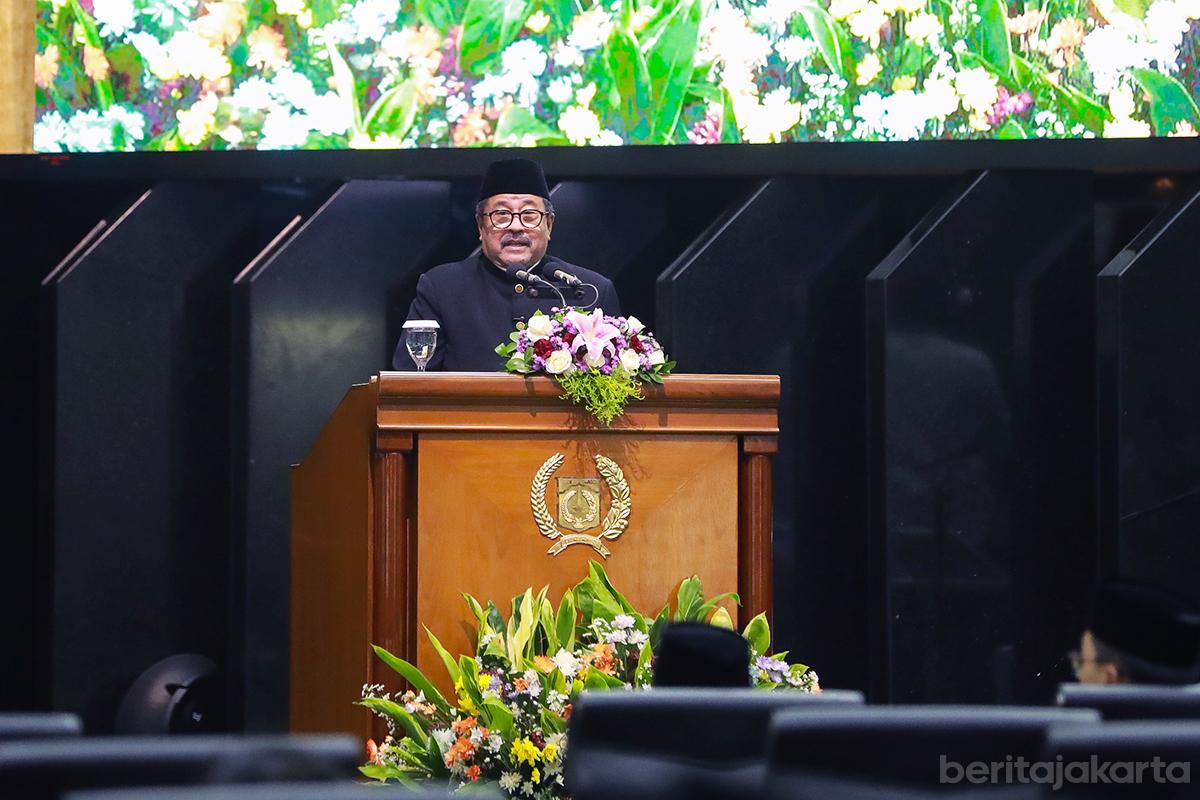
Reading a speech on behalf of Jakarta Governor Pramono Anung, Vice Governor Rano Karno outlined the city's future vision and key development achievements during the Jakarta City Council (DPRD) plenary session commemorating Jakarta's 499th anniversary on Monday (6/22).
A momentum to strengthen Jakarta's role as Indonesia's economic hub and a global city
"For nearly five centuries, Jakarta has continued to grow alongside the changing times. Through various transformations, the city has evolved into a center of government, commerce, and culture, while also serving as a meeting place for people from diverse backgrounds," Rano said.
Rano emphasized that the anniversary celebration also serves as a momentum to strengthen Jakarta's role as Indonesia's economic hub and a global city, in line with Law No. 2 of 2024 on the Special Region of Jakarta.
"Amid global economic uncertainties, Jakarta has continued to demonstrate resilience and strong economic performance," he added.
He noted that Jakarta's economy grew 5.59 percent in the first quarter of 2026, closely aligned with national economic growth of 5.61 percent, while contributing 16.67 percent to the national economy.
Positive development performance was also reflected in controlled inflation, significant investment growth, and declining unemployment and poverty rates.
According to Rano, these achievements stem from collective efforts to support business development, expand employment opportunities, improve the investment climate, strengthen food security, and enhance public services.
Rano also highlighted progress in three fundamental sectors that serve as the foundation for a Jakarta that is not only economically advanced but also ensures every resident has the opportunity to grow, develop, and enjoy a better quality of life.
In education, the Jakarta Provincial Government provided first-phase diploma amnesty in 2026 for 2,026 students, with a budget allocation of Rp 3.95 billion.
The administration also distributed the first phase of Jakarta Smart Card (KJP) Plus program in 2026 to 707,477 students, with a budget of Rp 1.62 trillion.
In addition, the first phase of the 2026 Jakarta Excellent Student Card (KJMU) program was provided to 15,825 university students with a budget of Rp 142.43 billion. The administration also launched a Free Private School Program covering 103 private schools at the elementary, junior high, senior high, vocational high school, and special education levels.
Other initiatives include the PINTAR Elderly School program as a learning platform for senior citizens and preparations for a regional scholarship scheme to support Jakarta students pursuing higher education at domestic and overseas universities.
In the healthcare sector, the administration has advanced the construction of Royal Batavia Hospital in Cakung and preparations for a new regional hospital in Grogol Petamburan, both aimed at meeting international standards.
"We have also expanded home-based healthcare services with support from White Troops personnel stationed at auxiliary community health centers and deployed directly to residents' homes," Rano added.
The administration has also introduced 24-hour mental health services through JakCare, constructed four new Health Centers (Puskesmas) in Matraman Sub-district, Bale Kambang Urban Village, Glodok Urban Village, and Gedong Urban Village, and completed the full revitalization of five Puskesmas across Jakarta.
In the social sector, the city has distributed social assistance through the Jakarta Elderly Card (KLJ), Jakarta Disability Card (KPDJ), and Jakarta Child Card (KAJ) programs to 187,706 beneficiaries as of May 2026.
"Human development must be supported by a well-planned, livable, and sustainable city," Rano stressed.
To achieve this, the administration continues to improve urban areas, upgrade underdeveloped infrastructure, revitalize and digitize traditional markets, enhance sidewalks, and curb illegal parking attendants.
Rano said the Jakarta Provincial Government is also strengthening housing quality through the construction of low-cost rental apartments (Rusunawa) and neighborhood improvement programs involving the Family Welfare Movement (PKK), Jumantik, Dasawisma, and other communities.
"These efforts have produced tangible results, as reflected in the decline of slum areas in Jakarta, from 445 neighborhood units (RW) in 2017 to 211 in 2026," he explained.
He added that urban development efforts also include expanding green open spaces, revitalizing parks, constructing retention ponds, increasing water infiltration areas, and extending Car Free Day activities along Jalan HR Rasuna Said to create healthier and more eco-friendly public spaces.
The city administration is also promoting the Waste Sorting at Source Movement to encourage more responsible waste management practices starting from households and communities.
"As Jakarta continues moving toward a modern, inclusive, and integrated mobility system, the administration is advancing the construction of MRT Jakarta Phase 2A and LRT Jakarta Phase 1B to strengthen connectivity and public transportation integration," he added.
According to Rano, the development is part of a transit-oriented city planning approach that connects mass transportation with public spaces, economic areas, residential areas, and residents' activities.
This connectivity is strengthened through intermodal transport integration toward the Dukuh Atas area, free transportation services for 15 groups of residents, improved transportation access for island communities, and AI-based traffic management.
In carrying out its new role as a Global City, Rano explained that Jakarta is not only strengthening its economic and infrastructure sectors but also developing its appeal, identity, security, and international networks.
Therefore, Rano emphasized that the Jakarta Provincial Government continues to develop tourism, culture, the creative economy, and historical areas as new spaces for community interaction while also serving as attractions for visitors.
These efforts include the development of the Kota Tua area, revitalization of Setu Babakan as a center of Betawi culture, strengthening Pasar Baru as a historic commercial area, and the development of other strategic areas such as PIK and Pulogadung as new hubs for economic activities and urban public spaces.
Rano also said various sports, cultural, religious, and international-scale events continue to be held to strengthen Jakarta's position as a vibrant, open, and culturally rich city.
Alongside efforts to strengthen Jakarta as a Global and Cultural City, Rano acknowledged that the Jakarta Provincial Government continues to support the strengthening of Betawi traditional institutions.
He said the move is important to ensure the Betawi community can play a greater role as a strategic government partner in preserving the city's identity, maintaining unity, strengthening cultural values, and supporting Jakarta's future development.
Rano added that Jakarta's appeal must also be supported by a sense of security and modern governance. Therefore, the Jakarta Provincial Government is expanding the use of technology by integrating CCTV systems into a real-time city monitoring system connected with security personnel.
"This step is part of efforts to create more adaptive, measurable, responsive, and data-driven city governance," he said.
Efforts to strengthen mobility, connectivity, security, and urban governance have begun showing positive results.
This is reflected in Jakarta's improved ranking in the Global Cities Index, rising from 74th to 71st place, its ranking as the 17th city with the best public transportation system in the world, and its position as the second safest city in Southeast Asia.
These achievements have also encouraged Jakarta to continue learning and collaborating with cities around the world through partnerships with Shenzhen, Singapore, London, Berlin, and Guangzhou.
"Jakarta continues to strengthen urban mobility that is more connected, low-emission, sustainable, and globally competitive," he said.
According to Rano, these achievements highlight the importance of strong partnership between the Jakarta Provincial Government and the Jakarta DPRD.
Rano expressed hope that the strong partnership that has been established will continue to grow, enabling the formulation of policies and development programs that address residents' aspirations and needs while guiding Jakarta toward a more advanced, competitive, sustainable, and equitable future.
"One year from now, Jakarta will mark its 500th anniversary. This milestone should become a turning point for all stakeholders to prepare the city's future more seriously," he emphasized.
![<?//= $potret[0]->photo_filename ?>](https://multimedia.beritajakarta.id/photo/potret-jakarta/2026/06/iEev2ltg4JRC6XWZBUcYa9bWkdVWsuY3.jpg)