Monday, April 20th 2026 Reporter: Budhi Firmansyah Surapati Translator: Maria Inggita 452
(Foto: Nugroho Sejati)
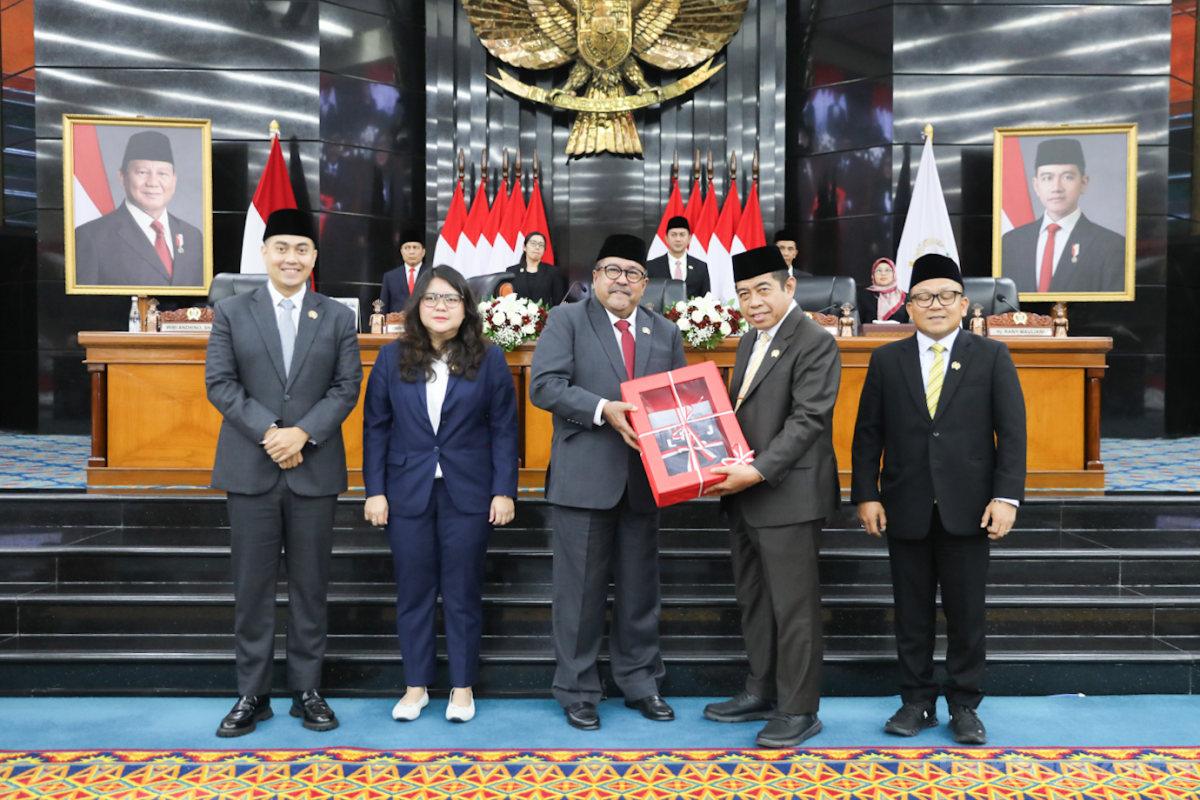
Jakarta Vice Governor Rano Karno presented the performance achievements and outcomes of several 2025 regional development priorities in the Governor's Accountability Report (LKPJ) for fiscal year 2025, delivered at a plenary session of the Jakarta City Council (DPRD).
In realizing Jakarta as a globally competitive, sustainable economic hub
"First, in education, the 12-year compulsory education program has been implemented through the distribution of education assistance for students from low-income families under the KJP Plus scheme," he said on Monday (4/20).
Rano noted that in 2025, KJP Plus reached 707,513 beneficiaries, while the Jakarta Excellent Student Card (KJMU) covered 16,920 beneficiaries in the second phase. Access to inclusive education was also expanded through 40 free private schools across five administrative cities.
In addition, 6,050 diplomas were returned to residents with support from BAZNAS (BAZIS), enabling residents to access job opportunities. Education funding included Rp1.45 trillion in School Operational Assistance (BOP) and Rp1.99 trillion in School Operational Funds across all levels.
In the health sector, access to comprehensive and sustainable healthcare improved, with the Universal Health Coverage Service Coverage Index reaching 80.07 percent and the Minimum Service Standards (SPM) health index achieving 100 percent.
Coverage under the National Health Insurance (JKN) reached 99.94 percent, with 4.25 million participants registered by the provincial government. Basic healthcare services were expanded through homecare services for residents with limited mobility, particularly the elderly, delivered by 292 coordinating nurses and 484 white troops personnel.
A 24-hour online mental health service via JakSehat has been accessed by 3,753 residents. Four health centers (puskesmas) were also built in Matraman Sub-district, Bareng Kambang Urban Village, Glodok Urban Village, and Bendungan Hilir Urban Village, alongside upgrades to five existing health centers, namely Puskesmas Senen, Pustu Meruya Selatan, Pustu Johar Baru 2, Pustu Pegangsaan, and Pustu Rorotan.
In the social sector, basic needs assistance programs reached 25,450 beneficiaries under the Jakarta Child Card, 25,519 under the Jakarta Disability Card, and 167,820 under the Jakarta Elderly Card.
In public works and spatial planning sector, water storage capacity increased to 539,674 cubic meters, while river dredging was carried out at 2,334 points with a total volume of 919,173 cubic meters. Floodwater was handled within two hours in 88.1 percent of cases, and 71.61 percent of the Thousand Islands coastline is now free from abrasion.
Access to wastewater management rose to 23.9 percent, with treatment capacity reaching 1,271 cubic meters per day. Safe piped water access reached 79.53 percent, while 1,002 water tanks were distributed to low-pressure areas. Road conditions remained stable at 97.35 percent, with 7.47 percent of pedestrian paths equipped with supporting facilities near mass transit areas.
In housing, occupancy of low-cost rental apartments (rusunawa) reached 85.89 percent. New developments began at three locations (Padat Karya Phase 2, Rorotan 9 Phase 1, and Margasatwa Cluster C), while 54 slum RWs covering 1,720.32 hectares were upgraded.
In the environmental sector, the Environmental Quality Index reached 55.28 percent, alongside improvements in water, land, and marine quality. Greenhouse gas emission reductions reached 26.96 percent, while waste management achieved 100 percent coverage, handling 5,280 tons per day.
Green open space (RTH) increased to 5.59 percent, or 3,773.56 hectares, through the development of parks, green corridors, and urban forests. Several parks were also revitalized, including 24-hour operations and integration of Ayodya, Langsat, and Barito parks into Bendera Pusaka Park.
In transportation, public transport use rose to 23.63 percent, with four new intermodal integration points added. Daily ridership reached 4.9 million trips, including Transjakarta, KRL, MRT, regular buses/angkot, and LRT Jakarta.
Expansion of rail-based transport continues, including MRT Jakarta Phase 2 (Bundaran HI–Kota), which reached 55.89 percent completion as of December 2025. Public transport coverage has expanded to 16 routes serving more than 21 million passengers.
In tourism, the sector grew by 9.66 percent, with 37.8 million visitors recorded, while the creative economy expanded by 9.42 percent.
In MSMEs, the number of digitally integrated Jakpreneur participants rose to 130.43 percent, while cooperative business volume increased by 4.89 percent.
In employment, the open unemployment rate fell to 6.05 percent in August 2025, down 0.16 percentage points year-on-year. Job fairs and employment programs absorbed 2,894 workers.
In food security, the Food Security Index reached 71.52, supported by urban farming, subsidized food programs, and interregional cooperation.
Investment realization reached Rp270.9 trillion, up Rp29.7 trillion from 2024, supported by improved business climate and licensing services through the Online Single Submission (OSS) system for 215,642 businesses.
In digital governance, the Electronic-Based Government System (SPBE) index reached 4.55, categorized as “satisfactory,” supported by the implementation of SPBE risk management, the development of Jaktive Super App, improved digital literacy, and the expansion of public internet access. These efforts also helped expand access to information and communication services through the operation of Jakwifi at 2,582 locations.
In civil service management, the merit system index reached 350.5, categorized as “very good,” supported by competency mapping and professional job placement, open recruitment, and employee development and recognition.
In public order and safety, enforcement of local regulations reached 96.6 percent, while disaster response met basic needs within 24 hours at a 100 percent rate.
Fire and rescue services achieved a 99.9 percent success rate, supported by the addition of 1,000 personnel.
Outside priority programs, Jakarta received Rp8.78 billion in deconcentration funds from six ministries/agencies, with Rp4.02 billion realized. Assistance funds from four ministries totaled Rp1.35 billion, with Rp600 million realized.
"May Allah SWT guide us in realizing Jakarta as a globally competitive, sustainable economic hub that ensures the welfare of all residents," Rano said.
![<?//= $potret[0]->photo_filename ?>](https://multimedia.beritajakarta.id/photo/potret-jakarta/2026/06/CMrmZITl4q1u5ESccT338EjEPy6hwMGd.jpg)