Monday, April 20th 2026 Reporter: Anita Karyati Translator: Nugroho Adibrata 438
(Foto: Anita Karyati)
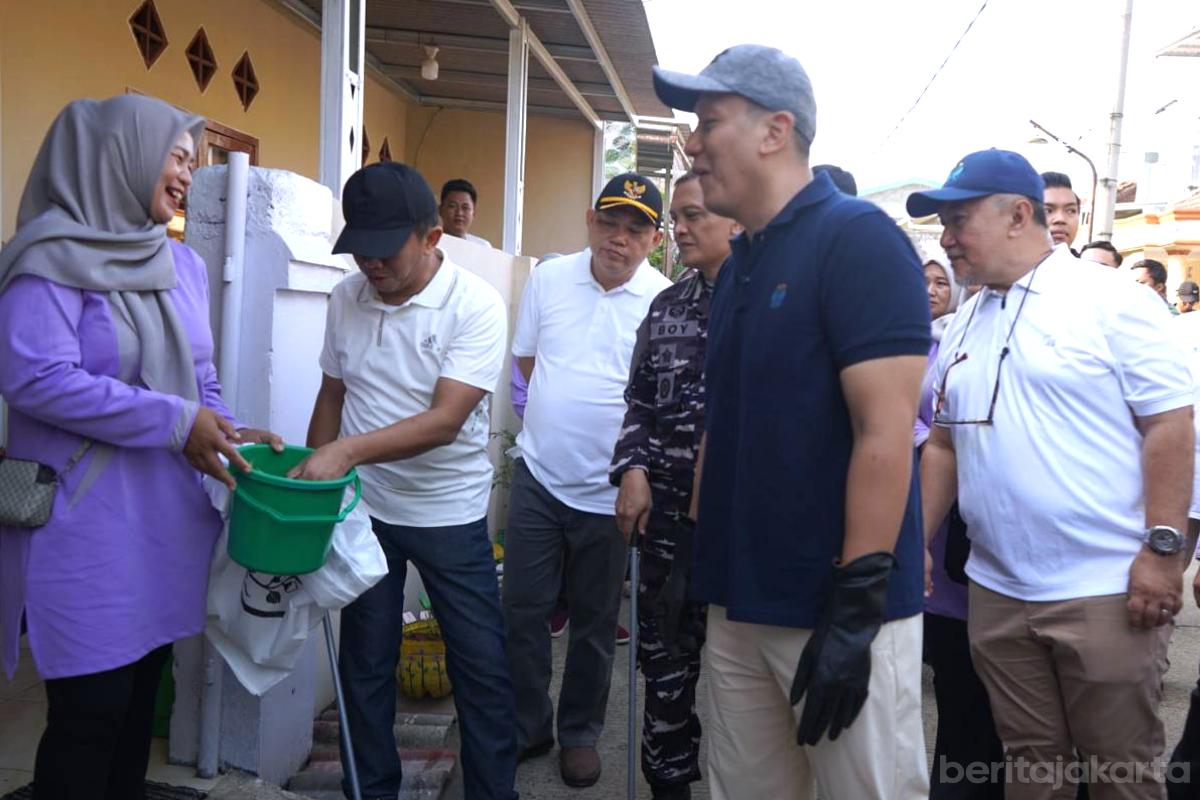
Rorotan Urban Village, located in Cilincing Sub-district, North Jakarta, has successfully reduced its daily waste output to the Bantar Gebang Landfill (TPST) by up to six tons. This achievement serves as concrete evidence of the success of the community-based '100 Percent Waste Sorting' program.
North Jakarta Environment Sub-agency Head, Edy Mulyanto said, Within approximately 1.5 months of the program's implementation, there has been a significant reduction in the volume of waste sent to the Bantar Gebang Landfill.
We manage about 21 to 25 tons of organic waste per month
"Out of a total population of nearly 60,000 in Rorotan, previously only about 5 percent of households sorted their waste. After more than a month of intervention, participation has increased drastically, directly resulting in a waste reduction of five to six tons per day," he stated, Monday (4/20).
He explained that organic waste is the biggest challenge in North Jakarta, accounting for nearly half of the 1,300 tons produced daily.
To resolve this, the office is intensifying education and improving the necessary infrastructure to ensure better waste handling.
These efforts include the distribution of 410 drop-point bins at the neighborhood level, 11,982 sorting buckets for households, 93 hanging scales, 650 'losida' (kitchen waste tubes), and 12 composting bins.
"We have also introduced waste processing technology support, such as shredders and bioreactors, to accelerate the decomposition of organic waste," he explained.
The waste management system in Rorotan has become more organized, they added. Residents separate their trash at the source before gathering it at drop-off points. Organic waste is moved to temporary storage sites to be turned into pulp for animal feed and maggot farming.
"We manage about 21 to 25 tons of organic waste per month. This alleviates the load on Bantar Gebang and fosters a circular economy within the community," he noted.
The achievement was also supported by the active involvement of Waste Sorting Movement (GPS) volunteers, PPSU maintenance workers, and environmental counselors, as well as collaboration with various parties, including private-sector CSR initiatives.
The North Jakarta City administration aims to model other regions after Rorotan’s success to ensure long-term sustainable waste management.
"Rorotan proves that with collaboration and a shift in behavior, waste reduction can be done quickly and effectively," he concluded.
Meanwhile, Juju (56), a GPS activist from RW 06, Rorotan, expressed her full support for the program. She noted, waste sorting is becoming a habit among residents, starting from their homes to the collection points.
"Thank God, there have been no difficulties. Residents are getting used to sorting their waste at home. We also continue to remind and assist others to ensure everything runs smoothly," she said.
She hopes the program will remain consistent and that people will not revert to the old habit of disposing of unsorted waste.
"I hope all residents remain committed. This is not just about a clean environment, but also for the future of our children and grandchildren," she emphasized.
![<?//= $potret[0]->photo_filename ?>](https://multimedia.beritajakarta.id/photo/potret-jakarta/2026/06/CMrmZITl4q1u5ESccT338EjEPy6hwMGd.jpg)